
Free eBook, AI Voice, AudioBook: How to Observe: Morals and Manners by Harriet Martineau
AudioBook: How to Observe: Morals and Manners by Harriet Martineau
0:00 / Unknown
Loading QR code...
You can listen full content of How to Observe: Morals and Manners by Harriet Martineau in our app AI Voice AudioBook on iOS and Android. You can clone any voice, and make your own AudioBooks from eBooks or Websites. Download now from the Mobile App Store.


Listen to the AudioBook: How to Observe: Morals and Manners by Harriet Martineau
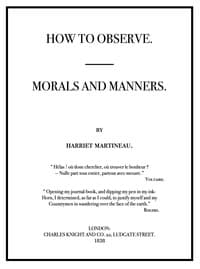
HOW TO OBSERVE.
MORALS AND MANNERS.
BY HARRIET MARTINEAU.
"Hélas! où donc chercher, où trouver le bonheur? ----Nulle part tout entier, partout avec mesure." VOLTAIRE.
"Opening my journal-book, and dipping my pen in my ink-horn, I determined, as far as I could, to justify myself and my countrymen in wandering over the face of the earth." ROGERS.
LONDON: CHARLES KNIGHT AND CO. 22, LUDGATE STREET. 1838.
LONDON: PRINTED BY SAMUEL BENTLEY, Dorset Street, Fleet Street.
ADVERTISEMENT.
"The best mode of exciting the love of observation is by teaching 'How to Observe.' With this end it was originally intended to produce, in one or two volumes, a series of hints for travellers and students, calling their attention to the points necessary for inquiry or observation in the different branches of Geology, Natural History, Agriculture, the Fine Arts, General Statistics, and Social Manners. On consideration, however, it was determined somewhat to extend the plan, and to separate the great divisions of the field of observation, so that those whose tastes led them to one particular branch of inquiry might not be encumbered with other parts in which they do not feel an equal interest."
The preceding passage is contained in the notice accompanying the first work in this series--Geology, by Mr. De la Bèche, published in 1835. Thus, the second work in the series is in continuation of the plan above announced.
PART I. REQUISITES FOR OBSERVATION.
INTRODUCTION
CHAP. I. Philosophical Requisites. Section I. Section II. Section III. Section IV.
CHAP. II. Moral Requisites
CHAP. III. Mechanical Requisites
PART II. WHAT TO OBSERVE
CHAP. I. Religion Churches Clergy Superstitions Suicide
CHAP. II. General Moral Notions Epitaphs Love of Kindred and Birth-place Talk of Aged and Children Character of prevalent Pride Character of popular Idols Epochs of Society Treatment of the Guilty Testimony of Criminals Popular Songs Literature and Philosophy
CHAP. III. Domestic State Soil and Aspect of the Country Markets Agricultural Class Manufacturing Class Commercial Class Health Marriage and Woman Children
CHAP. IV. Idea of Liberty Police Legislation Classes in Society Servants Imitation of the Metropolis Newspapers Schools Objects and Form of Persecution
CHAP. V. Progress Conditions of Progress Charity Arts
PART I. REQUISITES FOR OBSERVATION.
INTRODUCTION.
It has often been observed that men, even when well-intentioned, are very slow in adopting improved methods of procedure in any branch of study or action. This is particularly true of observation. Many, perhaps the majority, think that observation requires no previous instruction; that it is an instinctive faculty, which, like breathing or walking, develops itself sufficiently without culture. Yet, like every other faculty of the human mind, it is capable of great improvement by proper discipline. The general advice to "Observe!" is, in fact, almost useless to one who does not know what to look for, or how to look for it.
The object of the present volume is to supply hints for the observation of Morals and Manners. This subject is intimately connected with the science of society, and the moral character of a nation is, indeed, the most important element in its history and prospects.
To see clearly is the first requisite for accurate knowledge. The great difference between a careless glance and a steady, scrutinizing view is often the difference between error and truth. A man may travel over the surface of the earth, and yet know less of it than one who stays at home, if the latter has been taught how to observe, and the former has not. A traveller who merely records his impressions without reference to underlying principles, or without comparing what he sees with what he knows, will return with little more than an amusing collection of anecdotes, which afford no real insight into the character of the people he has visited.
If our object in travelling be to gain knowledge, we must know what questions to ask, and what phenomena to scrutinize. The natural philosopher is never at a loss for something to examine, because he has studied the laws of the physical world and knows what manifestations of those laws to seek. The moral philosopher or the traveller interested in man should be equally prepared.
This work is intended to be a guide for the traveller, the student of social science, or indeed, any person whose curiosity extends beyond the superficialities of everyday life. It aims to direct the attention to the less obvious, yet highly significant, indications of the moral and social state of any community or nation. The subjects treated are grouped in a manner intended to assist the memory and facilitate the application of the hints here offered.
The second great division of the work is devoted to What to Observe, while the first part considers the Requisites for Observation, both mental and material. It is a vital preliminary to understand that the state of one's mind, one's moral disposition, and even one's physical preparedness, significantly influence the quality and accuracy of what is perceived.
The importance of this subject cannot be overstated. A genuine observer sees the spirit of a people, their guiding principles, their weaknesses, and their capabilities for improvement. A mere spectator sees only the surface actions, which may often be deceptive or wholly irrelevant to the real condition of things.
We begin, therefore, with the philosophical foundation necessary for true seeing.
You can download, read online, find more details of this full eBook How to Observe: Morals and Manners by Harriet Martineau from



And convert it to the AudioBook with any voice you like in our AI Voice AudioBook app.
Loading QR code...