
Free eBook, AI Voice, AudioBook: The German Classics from the Fourth to the Nineteenth Century, Vol. 1 (of 2) by F. Max Müller
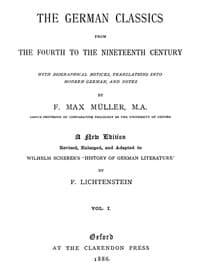
AudioBook: The German Classics from the Fourth to the Nineteenth Century, Vol. 1 (of 2) by F. Max Müller
0:00 / Unknown
Loading QR code...
You can listen full content of The German Classics from the Fourth to the Nineteenth Century, Vol. 1 (of 2) by F. Max Müller in our app AI Voice AudioBook on iOS and Android. You can clone any voice, and make your own AudioBooks from eBooks or Websites. Download now from the Mobile App Store.


Listen to the AudioBook: The German Classics from the Fourth to the Nineteenth Century, Vol. 1 (of 2) by F. Max Müller
A HISTORY OF GERMAN LITERATURE
BY W. SCHERER
TRANSLATED FROM THE THIRD GERMAN EDITION
BY MRS. F. C. CONYBEARE
EDITED BY F. MAX MÜLLER
THE GERMAN CLASSICS
FROM THE FOURTH TO THE NINETEENTH CENTURY
F. MAX MÜLLER
THE GERMAN CLASSICS FROM THE FOURTH TO THE NINETEENTH CENTURY WITH BIOGRAPHICAL NOTICES, TRANSLATIONS INTO ENGLISH, AND SHORT ESSAYS ON THE HISTORY OF GERMAN LITERATURE.
INTRODUCTION
Among the great languages of Europe, German holds a prominent position, both from the vast extent of territory over which it is spoken, and from the rich and copious literature that has sprung from it during the last thousand years. It is the language of philosophy, of science, and of a poetry which, though it may not always rival that of Greece or Rome in perfection of form, is certainly inferior to none in depth of thought and in the earnestness of its ethical tone. The history of this literature is the history of the German people, and to trace its gradual development from the earliest traces of its existence in the fourth century down to the present day, is to study the growth of the nation itself.
It is a history which, unlike that of French or Italian literature, is not confined to one political unit, but extends over several distinct kingdoms and states, differing widely in their social customs, political constitutions, and even in their dialects. Hence it is that the history of German literature is more complex and more difficult to write than that of many other nations. For a long time, indeed, German literature was, in a great measure, a literature of the Church, the scholars and the monks being almost the only writers and readers. Then followed a period when the court and the knightly classes took the lead, and gave rise to that wonderful blossoming of epic and lyric poetry in the twelfth and thirteenth centuries, of which the Nibelungenlied and the Minnesongs are the best known examples. After that came a long period of stagnation, interrupted only by the powerful influence of the Reformation, which gave a new direction to German thought and language.
The eighteenth century witnessed a revival, and the nineteenth has been fruitful beyond all expectation. It is true that, even at the present day, German literature is not always read as widely in England as that of France or Italy, but this is probably owing to the fact that the language itself is less generally studied. It is to be hoped that the present collection of representative texts, accompanied by English translations and critical essays, may contribute in some small degree to make German literature better known and better appreciated in England.
The present volume deals with the period from the fourth to the nineteenth century, and attempts to give a selection of the most important works and authors from the earliest monuments of the language down to the close of the eighteenth century. A second volume, which is in preparation, will bring the history down to our own time.
The text has been compiled from the most reliable editions, and the translations have been executed with a view to preserve, as far as possible, the spirit and tone of the originals, while at the same time rendering them into clear and idiomatic English. The biographical notices and essays are intended to supply the necessary historical and literary context, and to guide the reader in his appreciation of the extracts.
The history of German literature is divided into five main periods:
- The Old High German Period (from the fourth to the end of the eleventh century).
- The Middle High German Period (from the beginning of the twelfth to the end of the fourteenth century).
- The Early New High German Period (from the beginning of the fifteenth to the end of the sixteenth century).
- The Middle New High German Period (from the beginning of the seventeenth to the end of the eighteenth century).
- The Modern German Period (from the beginning of the nineteenth century to the present day).
The first period, which is chiefly represented by religious texts and glosses, is necessarily meagre in purely literary productions. The transition from the purely Germanic elements to the influence of Christianity is gradual, and the monuments we possess are fragmentary.
The Middle High German period, on the other hand, is rich and varied, showing the flourishing of courtly literature under the patronage of the Hohenstaufen emperors. The heroic epic, the courtly epic, and the lyric poetry of the Minnesingers mark the zenith of medieval German literature.
The following period, the Early New High German, is dominated by the Reformation, whose powerful influence transformed the literary landscape. Luther’s translation of the Bible was a momentous event, creating a standard for the written language and laying the foundation for modern High German.
The subsequent period, the Middle New High German, is marked by the devastating Thirty Years’ War and the long period of relative cultural decline that followed. While literature continued, it often lacked the vigor of earlier times, though the beginnings of a truly national literature towards the end of the eighteenth century promised a brighter future.
Finally, the Modern German Period bursts forth with the genius of Lessing, Herder, Goethe, and Schiller, creating a classical literature that stands among the greatest in the world.
This arrangement will be followed in the selections presented here, though the strict adherence to dates must occasionally yield to the nature of the materials available.
I. THE OLD HIGH GERMAN PERIOD (4TH-11TH CENTURY)
The earliest written records in the German language are extremely sparse, mostly consisting of glosses—single words or short phrases inserted into Latin texts to explain difficult Latin terms. The gradual Christianization of the Germanic tribes necessitated the translation of religious texts, which provided the first substantial body of written German.
The oldest piece of writing that can properly be called 'German' is the Abrogans, a Latin-German glossary compiled in the abbey of St. Gall around 770 A.D. It is not literature, but it shows the efforts made to provide a vocabulary for the Latin of the clergy.
The earliest coherent text of religious instruction is the Tatian or Evangelienharmonie, dating from the end of the eighth century, an attempt to combine the four Gospels into one continuous narrative in Old High German.
However, the true beginnings of German poetry are usually marked by the religious poems produced under Charlemagne’s influence.
Wessobrunn Prayer (Wessobrunner Gebet)
This short, powerful prayer, dating from the early ninth century, is remarkable because it contains an older, purely pagan passage describing the creation of the world before the Christian invocation. The dual nature of this fragment—pagan cosmogony followed by Christian faith—is highly significant.
Wêr sint unta dar niht wesan {10} nihtes, dar an engilu, sô dêmo hîu dar niht wesan nû dar nihtes.
hîu dar niht wesan dassâ dar âno, dar nihtes dassâ dar nihtes, dat nihtes. dassâ dar âno, dat nihtes.
Here was nought, and where nought was not, Nought was there, nor aught in the heavens, Where was then nought, where nought was not, Nought was there, then nought.
Then was nought, Where nought was not, Where nought was not, that nought was not. Where nought was not, there nought.
This opening, reflecting a pre-Christian Germanic worldview of void and nothingness, abruptly shifts to the Christian God:
Dat was êno hêrro, êno thîu âno dêm thîu, thîu dar âno. Dat was êno thîu, thîu dar âno. Dat was êno thîu.
Dat was êno thîu, thîu dar âno. Dat was êno thîu. Dat was êno thîu.
That was the Lord, before the world Before the world, the world was nought. That was the Lord, the world was nought. That was the Lord, the world.
That was the Lord, the world was nought. That was the Lord, the world. That was the Lord, the world.
This brief section serves as a profound introduction to the linguistic journey of German literature, bridging the pagan past with the Christian present.
Muspilli
Another significant text from the ninth century is the Muspilli (probably meaning 'Fire-trial'), a homily describing the Last Judgment. It is written in a more developed poetic style, focused heavily on eschatological themes. The description of the judgment seat of Christ is vivid and severe, characteristic of the religious intensity of the era.
The main interest of the Muspilli lies in its detailed depiction of the meeting of the souls of the righteous and the damned at the final judgment. The language is forceful, employing strong alliteration typical of Old Germanic verse, even as it struggles to contain Christian theology within older poetic structures.
The close of the Old High German period sees texts like the Hildebrandslied (a heroic lay fragment) and numerous religious glosses and hymns, but the linguistic unity is fractured as the dialects diverge further.
You can download, read online, find more details of this full eBook The German Classics from the Fourth to the Nineteenth Century, Vol. 1 (of 2) by F. Max Müller from



And convert it to the AudioBook with any voice you like in our AI Voice AudioBook app.
Loading QR code...