
Free eBook, AI Voice, AudioBook: A Christmas Carol in Prose; Being a Ghost Story of Christmas by Charles Dickens
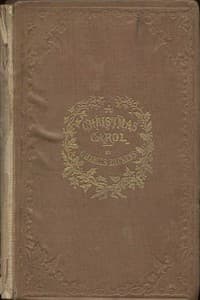
AudioBook: A Christmas Carol in Prose; Being a Ghost Story of Christmas by Charles Dickens
0:00 / Unknown
Loading QR code...
You can listen full content of A Christmas Carol in Prose; Being a Ghost Story of Christmas by Charles Dickens in our app AI Voice AudioBook on iOS and Android. You can clone any voice, and make your own AudioBooks from eBooks or Websites. Download now from the Mobile App Store.


Listen to the AudioBook: A Christmas Carol in Prose; Being a Ghost Story of Christmas by Charles Dickens
A CHRISTMAS CAROL
IN PROSE BEING A Ghost Story of Christmas
by Charles Dickens
STAVE I: MARLEY'S GHOST
MARLEY was dead: to begin with. There is no doubt whatever about that. The register of his burial was signed by the clergyman, the clerk, the undertaker, and the chief mourner. Scrooge signed it: and Scrooge's name was good upon 'Change, for anything he chose to put his hand to. Old Marley was as dead as a door-nail.
Mind! I don't mean to say that I know, of my own knowledge, what there is particularly dead about a door-nail. I might have been inclined, myself, to regard a coffin-nail as the deadest piece of ironmongery in the trade. But the wisdom of our ancestors is in the simile; and my unhallowed hands shall not disturb it, or the Country's done for. You will therefore permit me to repeat, emphatically, that Marley was as dead as a door-nail.
Scrooge knew he was dead? Of course he did. How could it be otherwise? Scrooge and he were partners for I don't know how many years. Scrooge was his sole executor, his sole administrator, his sole assign, his sole residuary legatee, his sole friend, and sole mourner. And even Scrooge was not so dreadfully cut up by the sad event, but that he was an excellent man of business on the very day of the funeral, and solemnised it with an undoubted bargain.
The mention of Marley's funeral brings me back to the point I started from. There is no doubt that Marley was dead. This must be distinctly understood, or nothing wonderful can come of the story I am going to relate. If we were not perfectly convinced that Hamlet's Father died before the play began, there would be nothing more remarkable in his taking a stroll at night, in an easterly wind, upon his own ramparts, than there would be in any other middle-aged gentleman rashly turning out after dark in a breezy spot--say Saint Paul's Churchyard for instance-- literally to astonish his son's weak mind.
Scrooge never painted out Old Marley's name. There it stood, years afterwards, above the warehouse door: Scrooge and Marley. The firm was known as Scrooge and Marley. Sometimes people new to the business called Scrooge Scrooge, and sometimes Marley, but he answered to both names. It was all the same to him.
Oh! But he was a tight-fisted hand at the grind-stone, Scrooge! a squeezing, wrenching, grasping, scraping, clutching, covetous, old sinner! Hard and sharp as flint, from which no steel had ever struck out generous fire; secret, and self-contained, and solitary as an oyster. The cold within him froze his old features, nipped his pointed nose, shrivelled his cheek, stiffened his gait; made his eyes red, his thin lips blue; and spoke out shrewdly in his grating voice. A frosty rime was on his head, and on his eyebrows, and his wiry chin. He carried his own low temperature always about with him; he iced his office in the dog-days; and didn't thaw it one degree at Christmas.
External heat and cold had little influence on Scrooge. No warmth could warm, no wintry weather chill him. No wind that blew was bitterer than he, no falling snow was more intent upon its purpose, no pelting rain less open to entreaty. Foul weather didn't know where to have him. The heaviest rain, and snow, and hail, and sleet, could boast of the advantage over him in only one respect. They often "came down" handsomely, and Scrooge never did.
Nobody ever stopped him in the street to say, with gladsome looks, "My dear Scrooge, how are you? When will you come to see me?" No beggars implored him to bestow a trifle, no children asked him what it was o'clock, no man or woman ever once in all his life inquired the way to such and such a place, of Scrooge. Even the blind men's dogs appeared to know him; and when they saw him coming on, would tug their owners into doorways and up courts; and then would wag their tails as though they said, "No eye at all is better than an evil eye, dark master!"
But what did Scrooge care! It was all the same to him. Scrooge was not the man to be intoxicated with the scent of holly or ivy. Like blundering puppies, dogs would leave their masters by the fire, and trot to Scrooge, and stay there; whining and subspiring, as if he were a Christmas turkey stuffed with sage and onions, too good to be eaten, and meant to be adored from a distance.
He was sitting in his usual gloom-enshrouded little counting-house a few days before Christmas: the fog and darkness pressing so heavily outside that in the office it was darker than midnight; Scrooge kept his little office window as partially open as if it were necessary to air his money: of which, by the way, he had a very comfortable sum put by at the Bank.
The clerk, a miserable thin little man, with brief beneath his arms, crept a most doleful sound, like a mouse scratching its head upon the door.
"What do you want?" Scrooge demanded in a voice that made the fog without, seem warmer by the noise alone.
"Please, sir, the door was not quite shut," said the clerk.
"It was shut then?" said Scrooge; opening his pair of eyes sharply, and looking at the man as if he were a coffin-nail himself, and he was the one to drive him home.
"It was, sir, now," replied the clerk.
"Then don't open it again, unless you have my express order! You'll catch your death of cold if you do," said Scrooge, and took up his pen again as if nothing had happened.
The clerk hurried to shut the door again, and, rather than being caught out in any other mistake, got his glove on one hand, though it was cold enough for both.
"A merry Christmas, uncle!" said a cheerful voice. It was the voice of Fred, Scrooge's nephew.
Scrooge seized his pen as if it were a weapon, and muttered, "Bah!"
"Nephew!" said Scrooge; "Bah!" was all he uttered.
"Christmas a humbug, uncle!" said Fred. "You don't mean that! Surely you don't mean that!"
"I do," said Scrooge. "Merry Christmas! What right have you to be merry? What reason have you to be merry? You're poor enough!"
"Come, then," returned the nephew gaily, "What right have you to be dismal? You're rich enough."
Scrooge, being now quite satisfied of his poverty, had no further answer. He had so little to say on the subject of his wealth, that he could only squeeze it out in the short sharp words, "Bah! Humbug!"
"Don't be angry, uncle!" said the nephew. "Pray uncle! Christmas time is drawing near, when all men, even you, forget what they usually keep, and to their better nature once a year show a briefly touching, but ultimately vain, desire to give each other something and forgive."
You can download, read online, find more details of this full eBook A Christmas Carol in Prose; Being a Ghost Story of Christmas by Charles Dickens from



And convert it to the AudioBook with any voice you like in our AI Voice AudioBook app.
Loading QR code...