
Free eBook, AI Voice, AudioBook: Brazil, the land of rubber - At the third international rubber and allied trades exhibition, New York, 1912 by 1912 Exposição internacioncal de borracha de New York Brazil. Commissão
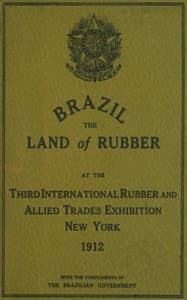
AudioBook: Brazil, the land of rubber - At the third international rubber and allied trades exhibition, New York, 1912 by 1912 Exposição internacioncal de borracha de New York Brazil. Commissão
0:00 / Unknown
Loading QR code...
You can listen full content of Brazil, the land of rubber - At the third international rubber and allied trades exhibition, New York, 1912 by 1912 Exposição internacioncal de borracha de New York Brazil. Commissão in our app AI Voice AudioBook on iOS and Android. You can clone any voice, and make your own AudioBooks from eBooks or Websites. Download now from the Mobile App Store.


Listen to the AudioBook: Brazil, the land of rubber - At the third international rubber and allied trades exhibition, New York, 1912 by 1912 Exposição internacioncal de borracha de New York Brazil. Commissão
BRAZIL COURT
Brazil occupies no less than ten thousand square feet of space on the Balcony Floor. The Exhibit is specially comprehensive. There is a fine archway to each entrance to the court dominated by the arms of the Federal Government. An Information Bureau is provided, at which all enquiries as to Brazilian rubber will be answered. The walls are hung with statistics and maps of the country. Close by are the offices of the Brazilian Commissioners and a refreshment kiosk, where the Federal Government dispenses Brazilian coffee to visitors.
One of the first things to strike the eye is the huge recumbent figure of the Rubber Colossus, overlooking the mighty Amazon and its innumerable tributaries, all of them highways of the rubber collecting industry. From this point the visitor may, with the assistance of a number of pictures, 22 feet by 12 feet, take a bird’s eye view tour up the Amazon. Alongside these pictures is a unique collection from the different States of Brazil of rubber and other products, the preponderance of the rubber industry being illustrated by a fine pyramid of caoutchouc. Dotted here and there are life-sized models of Brazilian workmen in their native costumes.
Arriving at the entrance to the Amazonas Section we find Dr. Pinto actually engaged in the coagulation of latex by his new smokeless process, which manufacturers have admitted turns out excellent rubber and which has the great advantage over the native system hitherto in vogue, of saving an enormous amount of both time and labor, whilst giving splendid results. A second series of pictures affords a vivid idea of the salient features of the State of Amazonas. In this section we have a mountain of rubber, and a ball which weighs 1,600 pounds. There is a fine picture of a native tapping a rubber tree and numerous very beautiful photographs. That nothing may be wanting to the completeness of the representation of Brazil’s great rubber industry a series of Moving Pictures is shown in the Main Hall of the Exhibition, which visitors will find particularly instructive after they have gone through the Brazilian Section on the Balcony Floor.
INTRODUCTION
Brazil, with its vast and immeasurable virgin forests in the valley of the Amazon, undoubtedly the greatest in the world, traversed by innumerable tributaries, many of which are larger and deeper than many of the rivers in other countries, can be considered the largest storehouse of native rubber of the best quality, all ready to be extracted, coagulated and applied to all kinds of industries. No other investment of capital can be as remunerative as that invested in the extraction of the native rubber from full grown trees, already existing in large quantities of many millions, and in zones full of natural richness.
For the culture of rubber trees of the various species, the whole northern and central portions of Brazil are well adapted, and will give magnificent results in the near future.
Nature has prodigally provided easy means of communication by waterways broad and deep. The climate is equitable without great variations of temperature, which gives perpetual summer and produces large and nearly uninterrupted harvests of agricultural products.
The difficulties which hinder the rapid development of the extraction of rubber are the obstructions in rivers in certain places, at certain seasons of the year when the water is low, and the fact that the production of rubber is so remunerative that all the vigorous men that are thus engaged do not care to engage in any other industry. Thus it is that living in the rubber regions is very expensive because everything must be brought there, even implements and foodstuffs.
These difficulties, however, have been brought to the attention of the Federal Government of Brazil, and of the States, and in consequence an important Congress was called and presided over by the Minister of Agriculture, Industry and Commerce. The Legislative power also passed special laws providing measures urgently needed to better the existing conditions. These laws also provide for a department under the Minister of Agriculture, Industry and Commerce, to be called “The Protection of Rubber,” which has already been formed and is at work.
Among the various and important provisions of the law, is the establishment of various experimental stations for advancing the cultivation of the four different kinds of rubber trees found in Brazil, the Hevea braziliensis (seringa), castillôa (caucho), maniçoba, and mangabeira.
You can download, read online, find more details of this full eBook Brazil, the land of rubber - At the third international rubber and allied trades exhibition, New York, 1912 by 1912 Exposição internacioncal de borracha de New York Brazil. Commissão from



And convert it to the AudioBook with any voice you like in our AI Voice AudioBook app.
Loading QR code...